
Don’t let your dog eat bones…. That is the lesson.
 If they do, here’s how to assure rapid recovery from emergency surgery!
Last week we hosted a back yard birthday party to which we invited the neighbors. We had a great spread of food, including lamb chops, chicken wings and veggies.
Crypto, my nearly five year old Bernedoodle, is always wanting to be out where there is food, but we didn’t want to have him get into the food, so he was left indoors.
Somehow, he got let out. He immediately went to the trash and gulped down a small T-bone from a lambchop.
Gulp! Indeed!
He tried to evacuate the bone by throwing up a time or two, but was not successful.
My husband put him in the car and sped off to the Emergency Vet clinic in our town.
At the clinic, the surgical team tried to pull it out while he was under sedation, using some long handled pincher of some sort. They broke a couple pieces off the bone, but couldn’t dislodge the bone and pull it out.
After trying for more than an hour, they gave up and we had the choice of seeing if it would pass through his system or surgery.
We opted for emergency surgery. My gut told me that was the best choice. The vet agreed upon completion of the surgery.
What Does This Have To Do With Homeopathy?
Unfortunately, there is no remedy to induce vomiting or dissolve a bone. But there are great options for post-surgical recovery.
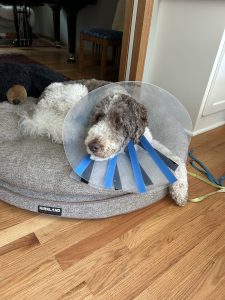
We brought him home the next afternoon. (The surgery was about 11:00 p.m.) We were sent with two types of pain pills, and a pill to dissolve and squirt down his throat with a syringe to help prevent problems with his esophagus. They also gave us four cans of really disgusting dog food. It was supposed be easier to digest. And yes, he also received a “cone of shame.” He looked horribly embarrassed at first.
I took one look at the dog food label and quickly decided that the mystery meat in there was going to make him puke (the worst thing for healing up an abdominal and stomach incision).
We stuck with his usual diet. We fed him less and we added rice and cooked the meat rather than leaving it raw.
In addition to the pain meds, which he clearly needed when we first brought him home, I gave him some homeopathic Arnica 200c.
What is Arnica?
For those of you who are new to homeopathy, Arnica is a homeopathic remedy that is often indicated when there has been physical trauma. (Surgery definitely fits in the realm of physical trauma.) He got a dose almost as soon as we arrived home. And another before bed.
We gave the remedy an opportunity to work and then also gave him his pain pills.
One of the pain pills, Gabapentin, put him to sleep. It was great that he had it. Crypto is an active dog, frequently jumping into bed with us and then going back down to the floor when he felt like it. We didn’t think this was a good idea, given the circumstances.
 After getting 3 more doses of Arnica the next day, Crypto was no longer acting like a dog who was recovering from surgery. He jumped into bed with us that second night and also jumped down from the bed. We have a rather high bed. ( We since have put chairs on the sides of the bed so he can’t jump in and out.)
After five days, he is acting like he is completely healed–which he isn’t, so we are still making him lay low. Today, we had a follow up appointment with his own vet just to check out the incision and make sure everything is healing properly and there are no issues.
He had no swelling, no fluid buildup. All in all, the incision was healing amazingly quickly, according to the vet.
But, we continue having him live the relaxed life. He still gets his pain pills, especially before bed just to keep him asleep and lying still as much as possible.
He also continues to get Arnica 200c 3x per day. Since we can’t ask him whether he still has pain, we are just continuing, and may drop it to two times per day, depending on what we notice on his skin and in his behavior.
Dosing Arnica
You might be wondering what the 200c means after the name of the remedy. It is an indicator of what ratio the remedy is diluted (C is Roman numeral C, so it is diluted a ratio of 1 in 100.)
The number in front of the letter refers to how many cycles of dilution took place.
If this were for a human who had just had abdominal surgery, I would likely have given this person 1M. A 1M potency is really 1000c—M being Roman Numeral 1,000. And just a side note, had he not done well with the Arnica, I had a second remedy in mind, that is a specific for abdominal injuries.
But pets are very sensitive to all sorts of things, including remedies, so I didn’t feel it was necessary to use such a high potency. And I clearly was correct in this assessment as he is doing extraordinarily well.
His staples come out next week. The staples were chosen because he is such an active dog. The stitches will dissolve on their own.
I’m so grateful for homeopathy and how much it helped Crypto. He is definitely doing better than he would have on just pain meds alone. I can be assured that the stitches we can’t see, the ones in his stomach, are also healing well.
Homeopathy and Pets
One of the reasons I became a homeopath was due to my success in helping my Akitas years ago. One had digestive issues, and the other had problems with being able to hold her bladder.They both lived long lives without those problems after well chosen homeopathic remedies.
Is your pet experiencing health problems that seem unsolvable? Please schedule a Holistic Health Huddle appointment and we can chat about what is going on with your furry friend.

 Some of you know me, others of you may have heard of me. And for most, you probably have no clue about me or my business. So I wanted to take a few minutes to introduce myself, my family, my business, why I am a homeopath and how I became a homeopath—not necessarily in that order.